
Cart items:

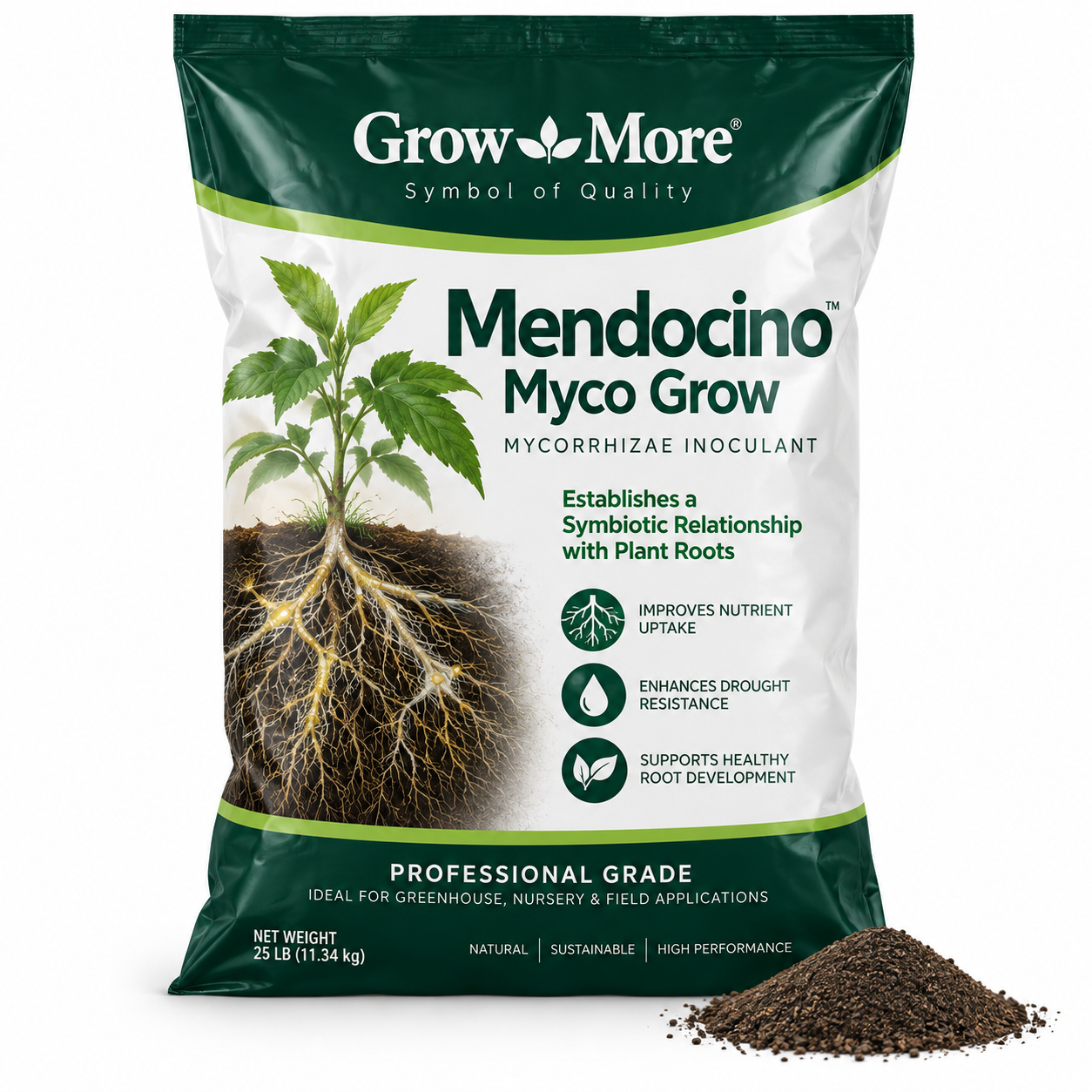
Grow More Mendocino Myco Grow Mycorrhizal Inoculant - 25 lb
GRM5173

Rootline Supply Co. provides reliable tools and products for growers, gardeners, and...
City: US, Grand Rapids
Our Advantages
- Competitive Price Matching
- Fast & Discreet Shipping (2-3 days)
- Safe & Secure Shopping
- High Quality Trusted Brands
Buying Multiple Units?
ACH Payments Available
8-Species Mycorrhizal Inoculant That Extends Root Reach Beyond a Plant's Own Roots
A plant's own root hairs can only reach so far, and in many soils the nutrients and water just outside that reach go untapped. Grow More Mendocino Myco Grow inoculates roots with 8 species of endomycorrhizal and ectomycorrhizal fungi that form a symbiotic network extending the effective root system well beyond what the plant could access alone, increasing the surface area available for nutrient and water absorption.
The blend combines three endomycorrhizal (VAM) species — Glomus intraradices, Glomus aggregatum, and Glomus mosseae — with five ectomycorrhizal species — Suillus granulatus, Pisolithus tinctorius, Rhizopogon rubescens, Scleroderma cepa, and Scleroderma citrinum — for broad host-plant compatibility, plus 1.0% humic acid from Leonardite to help the colonies establish.
Key Features & Benefits
- 8 Mycorrhizal Species: Combines 3 endomycorrhizal and 5 ectomycorrhizal species for colonization across a wide range of host plants.
- Expands Effective Root System: The fungal network formed with host roots extends nutrient and water access well beyond the plant's own root hairs.
- Improves Uptake of Hard-to-Reach Nutrients: Particularly effective at accessing phosphorus, zinc, copper, and water in soil microsites roots alone can't reach.
- Supports Disease Tolerance: Mycorrhizal colonization is associated with improved tolerance to soil-borne pathogens and environmental stress.
- 1.0% Humic Acid (Leonardite): Provides a carbon-rich substrate that supports mycorrhizal colony establishment in the rhizosphere.
Who Should Use This
Growers building a biologically oriented program — from large-scale field production to high-performance indoor cultivation — are the direct fit, especially at transplant or when establishing new plantings. Work it into the transplant hole or root zone for direct spore-to-root contact, and avoid pairing with systemic fungicides that could suppress colonization.
About Grow More Inc.
Grow More Inc., founded in 1918 in Hollywood, California as National Chemical Company and now headquartered in Gardena, California, offers a Mendocino biological and supplement line that includes this multi-species mycorrhizal inoculant.
Frequently Asked Questions
- What is the difference between endomycorrhizae and ectomycorrhizae?
- Endomycorrhizal fungi, including the Glomus species in Myco Grow, penetrate root cell walls to form an intimate nutrient-exchange interface, while ectomycorrhizal fungi form a sheath around the root's outside instead. Different plant species favor one type or the other, which is why Myco Grow blends both.
- How long does it take for mycorrhizal colonization to establish?
- Colonization can start within days of spore-to-root contact and become functionally established within 2 to 4 weeks under favorable conditions. Visible benefits — improved vigor and growth rate — typically show up within 3 to 6 weeks.
- Will synthetic fertilizers harm the mycorrhizal fungi?
- Very high soluble phosphorus levels can suppress colonization, since plants with abundant available phosphorus have less incentive to maintain the symbiosis. Moderate, crop-appropriate phosphorus rates allow the fungi to coexist alongside a conventional program.
- Can Myco Grow be applied to established plants, not just at transplant?
- Yes, though inoculation works best at transplant when spores reach young roots directly. For established plants, work it into the soil at the drip line or apply as a soil drench during active spring root growth.
- Is Myco Grow compatible with soil fungicide programs?
- Systemic fungicides that move into root tissue can harm mycorrhizal fungi and should be timed carefully around inoculation. Contact fungicides applied to foliage or the soil surface have less impact on established colonies.
Brand
Grow More Inc.
Height (in)
22
Length (in)
3
Weight (lb)
25.1
Width (in)
14
GTIN
080986051739
No reviews found
Please sign in so that we can notify you about a reply