
Cart items:

Down to Earth Dolomite Lime | 5lb - OMRI Listed - (Case of 6)
$48.84 / $8.14 per unit
(minimum purchase of 6)
(minimum purchase of 6)
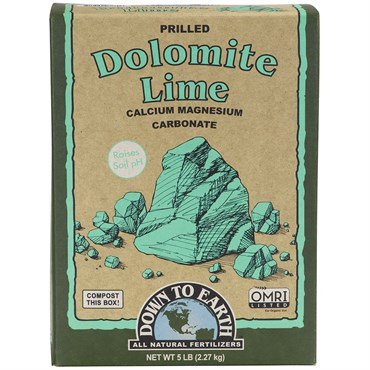
Down to Earth Dolomite Lime | 5lb - OMRI Listed - (Case of 6)
DTE07880

Rootline Supply Co. provides reliable tools and products for growers, gardeners, and...
City: US, Grand Rapids
Our Advantages
- Competitive Price Matching
- Fast & Discreet Shipping (2-3 days)
- Safe & Secure Shopping
- High Quality Trusted Brands
Buying Multiple Units?
ACH Payments Available
Granular Lime That Raises Soil pH While Adding Calcium and Magnesium Together, 5lb
When a soil test shows both calcium and magnesium running low alongside acidic pH, correcting all three with separate products is more work than most gardens need. Down To Earth Dolomite Lime addresses that combination directly, since dolomite is a calcium-magnesium carbonate rather than the calcium-only carbonate found in calcitic lime, and it's ground to an ultra-fine powder and prilled into uniform granules for an even spread and quicker reaction.
The 5lb bag, sold as a case of six, is convenient for home gardeners applying Dolomite Lime periodically to lawns, vegetable beds, or flower borders as part of routine soil pH management.
Key Features & Benefits
- Raises soil pH — sweetens acidic soil so nutrients including phosphorus and calcium become more available.
- OMRI Listed — approved for certified organic production.
- Supplies calcium and magnesium together — covers both secondary nutrients in one application rather than two separate amendments.
- Prilled uniform granules — ground to ultra-fine powder inside each granule for faster reaction than coarse lime.
Who Should Use Down To Earth Dolomite Lime
This suits organic gardeners, lawn care crews, and growers whose soil test shows acidic pH along with a magnesium shortfall, since dolomite corrects both in a single application rather than requiring calcitic lime plus a separate magnesium source.
About Down To Earth Dolomite Lime
Dolomite Lime is one of the mineral amendments in the OMRI Listed catalog Down To Earth Distributors has built at its Eugene, Oregon manufacturing facility since 1977, alongside its broader lineup of organic meals and liquid concentrates.
Frequently Asked Questions
- What's the difference between Dolomite Lime and calcitic Garden Lime?
- Dolomite Lime contains both calcium and magnesium carbonate, while calcitic lime (like Down To Earth Garden Lime) is primarily calcium carbonate. Choose dolomite when a soil test shows both nutrients are needed; choose calcitic lime when only calcium and pH correction are the goal.
- Is Down To Earth Dolomite Lime OMRI Listed?
- Yes, Dolomite Lime holds OMRI Listing. That covers both the calcium and magnesium content, since the mineral is used as-mined without synthetic additives.
- Why does raising soil pH improve fertilizer performance?
- In acidic soil, nutrients including phosphorus, calcium, and magnesium become less available to plant roots even when they're present in the soil. Raising pH into the optimal range improves that availability, so fertilizers you're already applying work more effectively.
- How fast does Dolomite Lime work once applied?
- The ultra-fine powder packed inside each prilled granule reacts faster than coarser lime products once watered in, though full pH correction still takes weeks rather than days. Follow up with a soil test to confirm the change.
- Should I test my soil before applying Dolomite Lime?
- Yes, a soil pH test tells you your current pH and the right application rate, since over-liming can push pH too high and actually reduce nutrient availability. Testing first avoids guessing at a rate that either under- or over-corrects.
Brand
Down To Earth Fertilizer
Height (in)
3.5
Length (in)
8
Weight (lb)
5.44
Width (in)
10.75
GTIN
714360078806
No reviews found
States
- United States: Alabama
- United States: Arkansas
- United States: Delaware
- United States: Florida
- United States: Georgia
- United States: Indiana
- United States: Iowa
- United States: Kansas
- United States: Louisiana
- United States: Maryland
- United States: Massachusetts
- United States: Minnesota
- United States: Mississippi
- United States: Missouri
- United States: Nebraska
- United States: Nevada
- United States: New Hampshire
- United States: New Jersey
- United States: North Carolina
- United States: North Dakota
- United States: Pennsylvania
- United States: Rhode Island
- United States: South Carolina
- United States: South Dakota
- United States: Tennessee
- United States: Texas
- United States: Vermont
- United States: West Virginia
- United States: Wisconsin
- United States: Wyoming
Please sign in so that we can notify you about a reply