
Cart items:
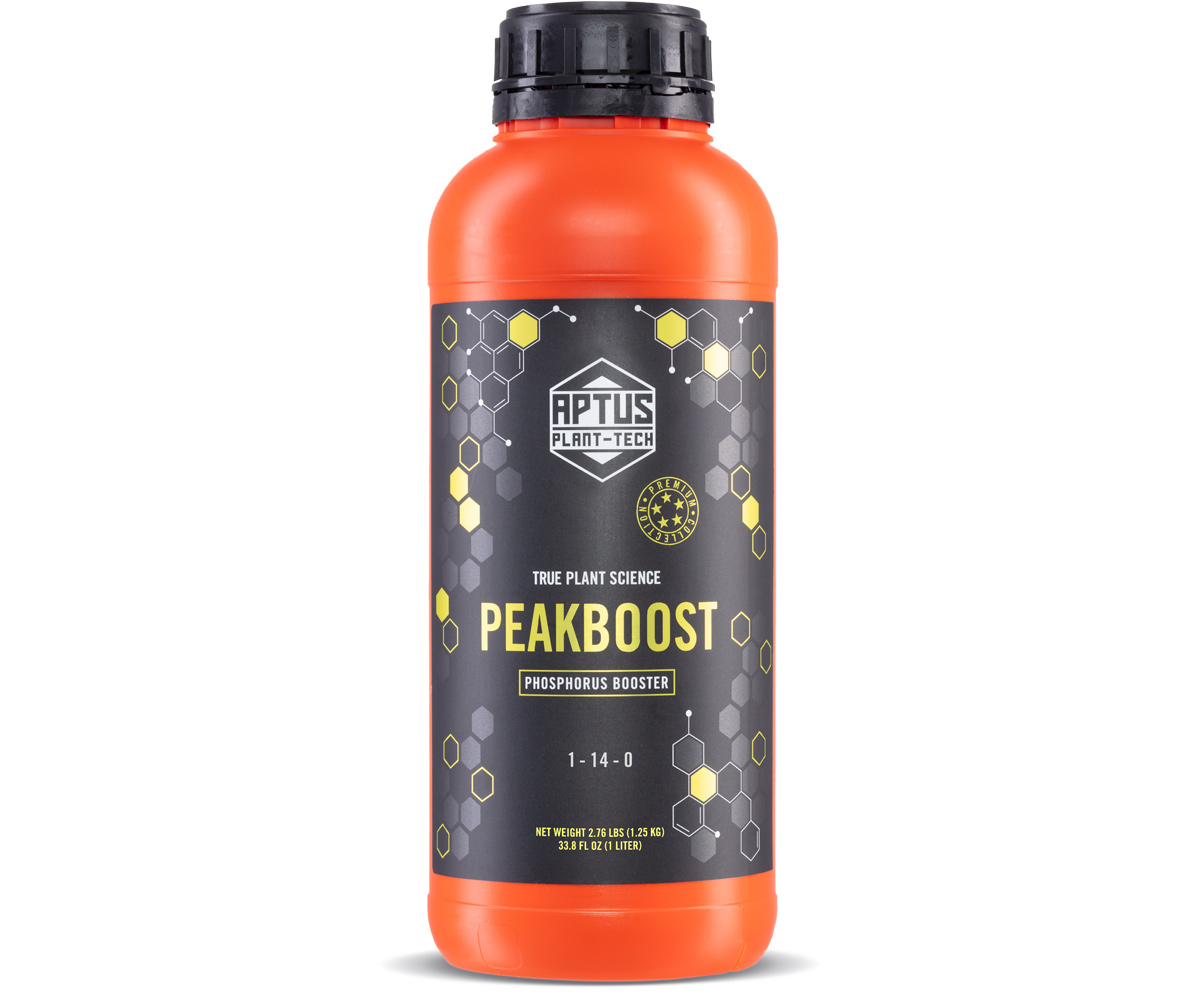
Aptus Peakboost Flowering Supplement - 1 L
AP20010

With a strong portfolio of manufactured and distributed brands, we are one of the lead...
City: US, Shoemakersville
Our Advantages
- Competitive Price Matching
- Fast & Discreet Shipping (2-3 days)
- Safe & Secure Shopping
- High Quality Trusted Brands
Buying Multiple Units?
ACH Payments Available
Isolate Phosphorus at Peak Bloom to Keep Your Trace Minerals Intact, 1 L
Most commercial bloom boosters combine phosphorus and potassium at high levels in a single product, and elevated phosphorus directly antagonizes zinc, iron, and copper uptake, blocking trace minerals the plant needs throughout the bloom cycle. Peakboost isolates plant-available phosphorus in its own product, removing potassium from the equation entirely during weeks 2 through 6, so the plant can run high phosphorus through peak bloom while keeping zinc, iron, and copper fully accessible in the root zone.
Peakboost ships in a 1 L container, sized for single-room growers running the weeks 2-6 phosphorus schedule.
Key Features & Benefits
- Isolated plant-available phosphorus — applies concentrated P without potassium, removing the antagonism that blocks trace mineral uptake in standard P-K bloom boosters.
- Zinc, iron, and copper preservation — keeping potassium out of the P-peak equation means these trace minerals stay accessible throughout weeks 2-6.
- Mineral antagonism prevention — keeps high-demand minerals from competing with each other during peak bloom.
- Weeks 2-6 timing — applied through the flower-building phase, then discontinued in weeks 7 and 8 when Finaleboost takes over.
- Dosage 6-16 ml per 5 gallons — escalates from 6 ml per 5 gal at week 2 to 16 ml per 5 gal by week 6 to match increasing P demand.
Who Should Use Aptus Peakboost
Growers in the peak-bloom phase who want to run elevated phosphorus without the mineral antagonism caused by standard P-K bloom boosters, preserving zinc, iron, and copper availability through weeks 2 to 6 of flower, with the 1 L size matched to garden scale.
About Aptus Peakboost
Aptus Plant Tech began developing soil- and plant-science-based nutrient research in the Netherlands in the 1990s and has grown into a hydroponic nutrient supplier distributing across Europe, North America, and Australia. Peakboost handles the phosphorus load during weeks 2 through 6; by week 5, growers begin introducing Finaleboost to handle the potassium load through final ripening, running both Peakboost and Finaleboost from weeks 5 to 6 to bridge the transition before Peakboost is dropped entirely.
Frequently Asked Questions
- Why must I stop using Peakboost in weeks 7 and 8?
- By week 7, the plant's phosphorus demand decreases while potassium demand peaks for ripening. Continuing Peakboost at that stage would create unnecessary P loading, so Finaleboost handles the potassium push through the final two weeks alone.
- How does Peakboost differ from standard P-K bloom boosters?
- Standard P-K products combine phosphorus and potassium in a fixed ratio, and high P antagonizes zinc, iron, and copper uptake. Peakboost isolates P entirely, so trace minerals stay accessible while running elevated phosphorus.
- What dosage rate does Peakboost use?
- It runs 6 to 16 ml per 5 gallons, escalating each week from week 2 through week 6. The low end of the range suits early bloom, while the high end matches the plant's approach to peak P demand in week 6.
- Can Peakboost be used during the vegetative phase?
- Yes, at 1 ml per gallon alongside the Aptus vegetative feeding chart to address purple stems caused by phosphorus deficiency. This is an occasional correction rather than a standard part of the veg routine.
Brand
Aptus
GTIN
670541797075
MPN
APT-PB-100
Product weight
3.05 lb
Length
3.5 in
Width
3.5 in
Height
9.5 in
Returns
30-day returns
No reviews found
States
- Oregon
Please sign in so that we can notify you about a reply