
Cart items:

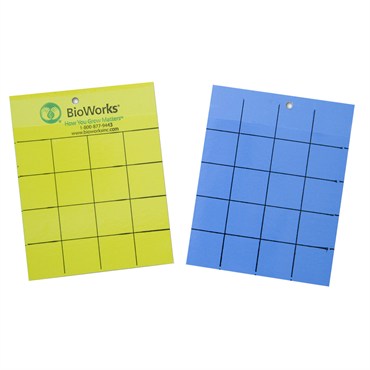
BioWorks Insect Monitoring Sticky Cards - 100-Count - Yellow/Blue
BW1GS40A41

Rootline Supply Co. provides reliable tools and products for growers, gardeners, and...
City: US, Grand Rapids
Our Advantages
- Competitive Price Matching
- Fast & Discreet Shipping (2-3 days)
- Safe & Secure Shopping
- High Quality Trusted Brands
Buying Multiple Units?
ACH Payments Available
Double-Sided Sticky Cards Covering Two Pest Groups in One Card
Monitoring for aphids and monitoring for thrips usually means hanging two different colors of sticky card side by side, since each color attracts a different set of flying pests. This card combines both in one double-sided format: the yellow side attracts flying aphids, whiteflies, fungus gnats, and leafminers, while the blue side attracts flying thrips, covering both pest groups from a single hang point.
Each 4in x 5in card carries a 1in counting grid on both sides for consistent pest counts over time, with weather-resistant construction, peel-off adhesive backing, and a pre-punched hole for hanging, packed 100 to a case.
Key Features & Benefits
- Double-sided yellow/blue format — yellow attracts aphids, whiteflies, fungus gnats, and leafminers; blue attracts thrips.
- 1in counting grid on both sides — makes pest counts fast and consistent for tracking population trends.
- 4in x 5in card size — sized for dense placement across benches and hanging plants.
- Weather-resistant construction — holds up in humid greenhouse conditions.
- Peel-off backing and hanging hole — quick, tool-free deployment.
Who Should Use This
Greenhouse managers, nursery operators, and IPM scouts running systematic pest monitoring programs who want one card type covering two major flying pest groups are the direct fit for this product.
About BioWorks
BioWorks, founded in 1993 in Victor, New York, supplies IPM scouting tools such as these sticky cards alongside its biological pest and disease control product lines.
Frequently Asked Questions
- What pests does each side of the card attract?
- The yellow side attracts flying adult aphids, whiteflies, fungus gnats, and leafminers. The blue side attracts flying adult thrips.
- How do I use the counting grid?
- Count the insects trapped within each 1in square and record counts by date and location. This lets you track population trends over time and flag areas with escalating pest pressure.
- How often should cards be replaced?
- Replace cards when the adhesive surface becomes covered, or on a routine schedule of roughly every one to two weeks as part of ongoing scouting. More frequent replacement may be needed in high-pest-pressure areas.
- Where should cards be placed for the best monitoring results?
- Hang cards at plant canopy height, roughly one card per 200 to 500 sq ft for general monitoring, with denser placement in known problem areas. Consistent placement over time gives the clearest population trend data.
Brand
Bioworks Inc
Weight (lb)
0.100
MPN
1GS40A41
No reviews found
Please sign in so that we can notify you about a reply