
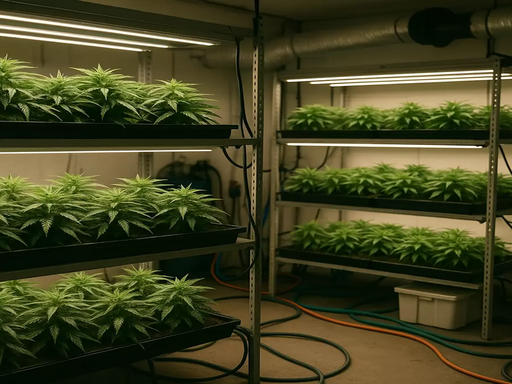
Moving from a reliable hobby room to a small commercial operation is a technical jump that rewards careful engineering. This guide focuses on the cultivation equipment, grow environments, and operational practices that experienced growers need to scale reliably and profitably.
Define throughput, power, and phasing
Start with clear targets: canopy area, plants per cycle, desired harvest cadence, and target PPFD or yield per square foot. Translate those targets into equipment and utility requirements before any build begins. Use the 80% rule on electrical circuits (don’t load breakers above 80% of rated capacity) and plan dedicated circuits for lighting and HVAC to avoid nuisance trips. Phase your build: establish a stable core environment (lighting, basic ventilation, monitoring) first, then add automation, CO2, and redundancy after you can consistently hit target environmental setpoints.
Lighting and heat management
Choose commercial LED fixtures rated by PPF and efficacy (µmol/J). For flowering/intensive canopy phases many operators size lighting in the 30–50 W/ft² range or target 600–1,000 µmol/m²/s PPFD depending on crop and fixture optics. Prioritize uniformity across the canopy — optics and lensing matter more than raw watts for even PAR distribution.
Practical tip: map fixture spacing and run a heat load calculation to determine sensible (lighting) and latent (plant transpiration) loads; these values feed your HVAC and dehumidifier sizing. If lighting heat exceeds passive capabilities, plan for staged HVAC or split systems to maintain setpoints without excessive cycling.
HVAC, dehumidification, and air movement
HVAC design must handle combined sensible and latent loads. Oversizing by a modest margin improves runtime and humidity control, but redundancy is as important as capacity: multiple smaller units or staged compressors are easier and cheaper to repair than a single oversized system. For dehumidification, size units to the latent load driven by plant transpiration at peak canopy; undersized dehumidifiers are one of the most common failure points in scale-ups.
Air movement over the canopy should prevent microclimates. Use inline centrifugal or axial fans for exhaust and make-up air, and distribute oscillating fans at canopy level for boundary layer control. Plan ducting routes, dampers, and condensate management up front.
Irrigation, fertigation, and water treatment
Decide early between run‑to‑waste and recirculating systems. Run‑to‑waste is simpler operationally but uses more water and nutrients. Recirculating systems save inputs but require robust filtration, UV sterilization, and tighter monitoring of EC and microbial loads. For consistent dosing, use peristaltic or diaphragm dosing pumps tied to EC/pH feedback loops and centralize nutrient mixing in a bulk prep tank with agitation.
Install RO and carbon filtration on feed water if local source variability is high. Use calibrated EC/TDS and pH meters in-line where possible, and keep handheld bench meters for verification with regular calibration logs.
Automation, monitoring, and QA
Invest in an environmental controller that integrates lighting, HVAC, dehumidification, CO2 (if applicable), and irrigation alarms. Data logging and remote alerts are essential once you manage multiple rooms or staggered cycles. Choose controllers with open APIs or modular expansion so you can add sensors and actuators without replacing the whole system.
Key sensors: PAR meter for light validation, thermohygrometers with remote logging, CO2 sensors for rooms using enrichment, leak/flood detectors in wet zones, and inline EC/pH probes for fertigation. Calibrate regularly and maintain a logbook or automated audit trail for every crop cycle.
Benching, vertical space, and sanitation
Rolling benches and modular racks maximize usable canopy in retrofit spaces. Multi‑tier setups multiply area but require careful fixture selection per tier and additional HVAC capacity. Choose corrosion‑resistant materials with casters for mobility and design benches for ease of cleaning and tray drainage. Build clear zoning: wet zones (mixing, reservoirs), clean zones (cloning/veg), and dirty/service zones to limit cross‑contamination.
Redundancy, spare parts, and commissioning
Plan spares for critical components: LED drivers, pumps, HVAC starters, and controller power supplies. Commission systems in phases and validate each subsystem under expected loads before adding plants. Run mock cycles with ballast or dummy loads to verify electrical staging, control setpoints, and emergency shutdowns.
Procurement and where to look
Cannavista carries the core categories you’ll need when scaling — from commercial LED fixtures and grow rooms to HVAC, dehumidification, CO2 systems, irrigation and fertigation equipment, benches and flood tables, water treatment, and environmental controllers. Explore their selection and vendor options to compare specs and warranties: Grow Equipment & Supplies on Cannavista. Use vendor datasheets to verify PPF/efficacy, IP ratings, and serviceability before purchasing.
Conclusion — phase, validate, iterate
Scaling from hobby to small commercial is an engineering project as much as a horticultural one. Phase your build, validate each subsystem under load, and prioritize HVAC, water consistency, and monitoring before pursuing marginal gains like CO2 enrichment or extreme lighting densities. If you want a tailored parts list or commissioning checklist for your room dimensions and target canopy, Cannavista’s catalog and support can help you specify the right equipment and redundancy plan:
https://cannavista.com/grow-equipment-supplies/