
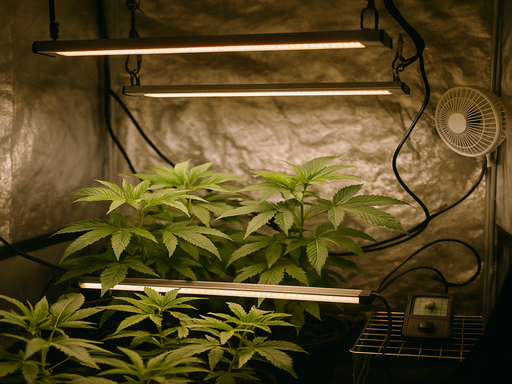
Even light across a canopy is one of the simplest and most impactful upgrades that yields consistent quality and improved plant performance. This comprehensive guide dives deeper into why light uniformity matters, how hotspots are created, and provides practical, equipment-focused strategies that you can apply in tents, small commercial racks, or multi-layer grow setups. You'll learn how to assess your current lighting setup, select the best fixtures and optics, optimize your layout, and use tools to fine-tune your system for ideal light distribution.
Why uniform light matters (and what creates hotspots)
Light uniformity is equally as important as total light intensity. Uneven lighting creates peaks and troughs in your canopy’s PPFD (photosynthetic photon flux density), forcing some plants to endure light stress while others remain shaded or underlit. This imbalance complicates crop cycle management and can reduce overall yield and quality. Hotspots frequently develop due to narrow beam optics, fixtures hung too close above the canopy, improper spacing, reflective surfaces not optimized for light distribution, or relying solely on a single intense point source.
Choose fixtures and optics that favor spread and overlap
When upgrading or designing your lighting setup, focus on footprint shape and beam angle as much as raw wattage or lumens. Here are practical options for achieving uniform lighting coverage:
- Wide-beam fixtures and diffused optics: These help smooth out the beam cone and reduce contrast between light and shadow. While peak intensity might slightly drop, uniformity improves — always measure before and after changes.
- Multiple lower-power fixtures: Spacing several smaller lamps evenly across your canopy produces steadier coverage than a single centralized high-power light.
- LED bars and strips: Linear fixtures work well for benches and tents. Position bars perpendicular to the planting rows and space them so their light footprints overlap smoothly.
- Consider proven models: Cannavista’s catalog highlights options like the MiracleLED 4ft daylight LED bars and SUNPACK T5HO systems. These are versatile, allowing you to build arrays with reflectors or stands to finely tune height and spread.
Tip: If you're currently using narrow-beam fixtures, consider adding diffusing panels or low-power secondary bars to fill coverage gaps before replacing your entire system.
Layout, spacing and hanging height: practical rules of thumb
Uniformity hinges on both spread and overlap. When designing or adjusting your layout, follow these operational guidelines:
- Overlap light footprints by 20–50%: Adjacent fixtures should share coverage to soften beam transitions and reduce max/min uniformity ratios.
- Raise fixtures to widen spread (while checking penetration): Increasing hanging height broadens the coverage area and improves uniformity, but watch for lower canopy light levels. When penetration drops, supplement with mid-canopy or interlighting bars rather than lowering the main fixtures.
- Use systematic grid spacing for measurements: In small tents, map PAR readings on a 12"–18" grid; for benches and rooms, 1 to 2-foot grids are effective. Use this detailed data to iteratively adjust spacing.
- Orient LED bars correctly: Run long bars across rows rather than along them to distribute light evenly plant-to-plant. Modular wiring and adjustable hang points let you rapidly adapt as the canopy grows or changes.
Tip: For new setups, mock your layout at working height using inexpensive shop lights or temporarily hung fixtures. Visualizing light footprint overlap before final mounting prevents costly rework.
Tools and add-ons that eliminate stubborn hotspots
If hotspot issues persist despite layout tuning, consider these equipment upgrades that refine your light distribution:
- Reflectors and high-reflectivity walls: Utilizing mirror-finish reflectors or reflective tent fabrics returns stray photons to shadowed zones and softens sharp contrasts. Position reflectors effectively to redirect light into shaded areas, not back at fixtures.
- Diffusers and opal covers: These smooth out concentrated beams, reducing intensity spikes. A modest peak PPFD drop may occur; you can compensate with supplemental low-power lighting.
- Light movers: Slow horizontal movement spreads light evenly over time, turning static hotspots into consistent illumination. This is especially useful if adding fixtures isn’t feasible.
- Interlighting for multi-layer systems: Add LED bars between canopy layers or under dense foliage to deliver light deeper into the plants, easing dependency on top-down light.
- Adjustable mounts and stands: Flexible mounting solutions allow you to fine-tune fixture heights and angles as your plants grow or canopy density changes.
Measure, iterate, and standardize for consistent results
Good light management is measurable and repeatable. Use a PAR (quantum) meter to create PPFD maps at your target canopy height:
- Collect grid measurements and calculate uniformity ratios (max/mean or max/min). Aim for a max/min ratio under 1.5:1; the best setups achieve below 1.3:1.
- Implement one change at a time (such as raising a fixture row, adding a bar, or adjusting spacing), then re-measure. Keep detailed records to revert or refine decisions.
- Reassess after major canopy growth phases. Changes in leaf architecture and plant height alter how light distributes, so remap every 1–2 weeks during rapid growth.
Tip: Maintain baseline PPFD maps for key canopy stages (early veg, mid-canopy, late canopy). This reference helps swiftly restore optimal light setups after maintenance or transplanting.
Extended troubleshooting checklist
- Map PPFD thoroughly to pinpoint hotspots and low-light zones.
- Raise fixtures to increase footprint spread; then verify canopy penetration remains adequate.
- Reposition fixtures for 20–50% footprint overlap and ensure LED bars are oriented perpendicular to crop rows.
- Add reflectors, diffusing panels, or interlighting to fill shadow gaps unreachable by main fixtures.
- Consider installing a light mover if consistent hotspots persist.
- Standardize your lighting setup and remeasure regularly as your crops develop.
- Use modular, adjustable mounting systems to adapt lighting quickly with plant growth.
Even small upgrades — swapping a narrow lens for a wider one, adding low-power LED bars, or incorporating a light mover — can resolve most uniformity issues without major overhauls. Start by carefully mapping your canopy’s light distribution to identify problem spots; this data guides whether you need to expand spread, increase overlap, or add supplemental in-row lighting.
Ready to optimize your grow room lighting? Browse Cannavista for lighting bars, T5 fixtures, diffusers, mounting hardware, and innovative uniformity solutions tailored for tents, benches, and multi-layer racks. Explore Cannavista today to compare specs and find the perfect components for your next lighting upgrade.